
WELL Blog
Notes on light, perception, and the experience of space
Beyond Visual Comfort in Indoor Lighting: Biological Impact
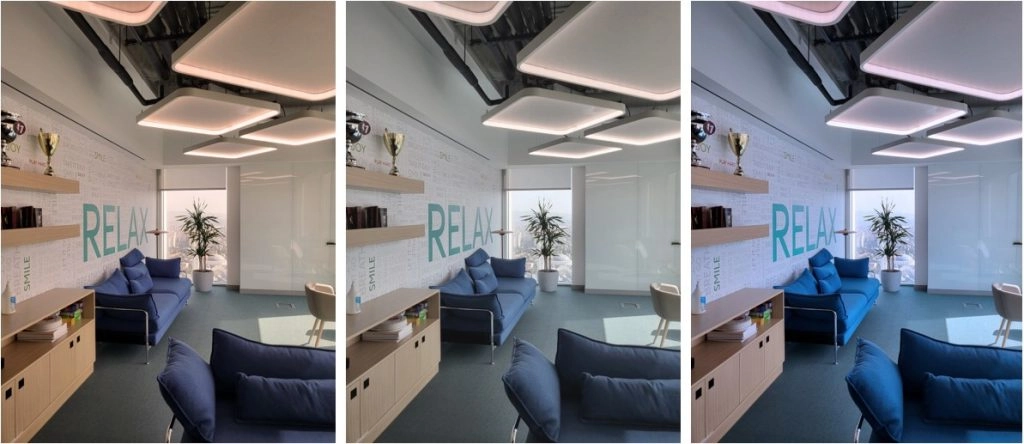
Lighting in Workplace Environments
Interior lighting design is not limited to providing visual comfort alone. Today, Human-Centric Lighting (Human Centric Lighting) approach is gaining increasing importance in workplace environments, owing to its effects on biological rhythm, hormone balance, and mental performance.
It's been cloudy in Istanbul for days. During periods when I work from home, I try to make sure that artificial lighting follows daylight as closely as possible on overcast days. In measurements I took yesterday around midday, I recorded 6,011 K / 5,740 lux (photopic) outdoors, and 5,300 K / 107 lux (photopic) indoors (with the lights off).
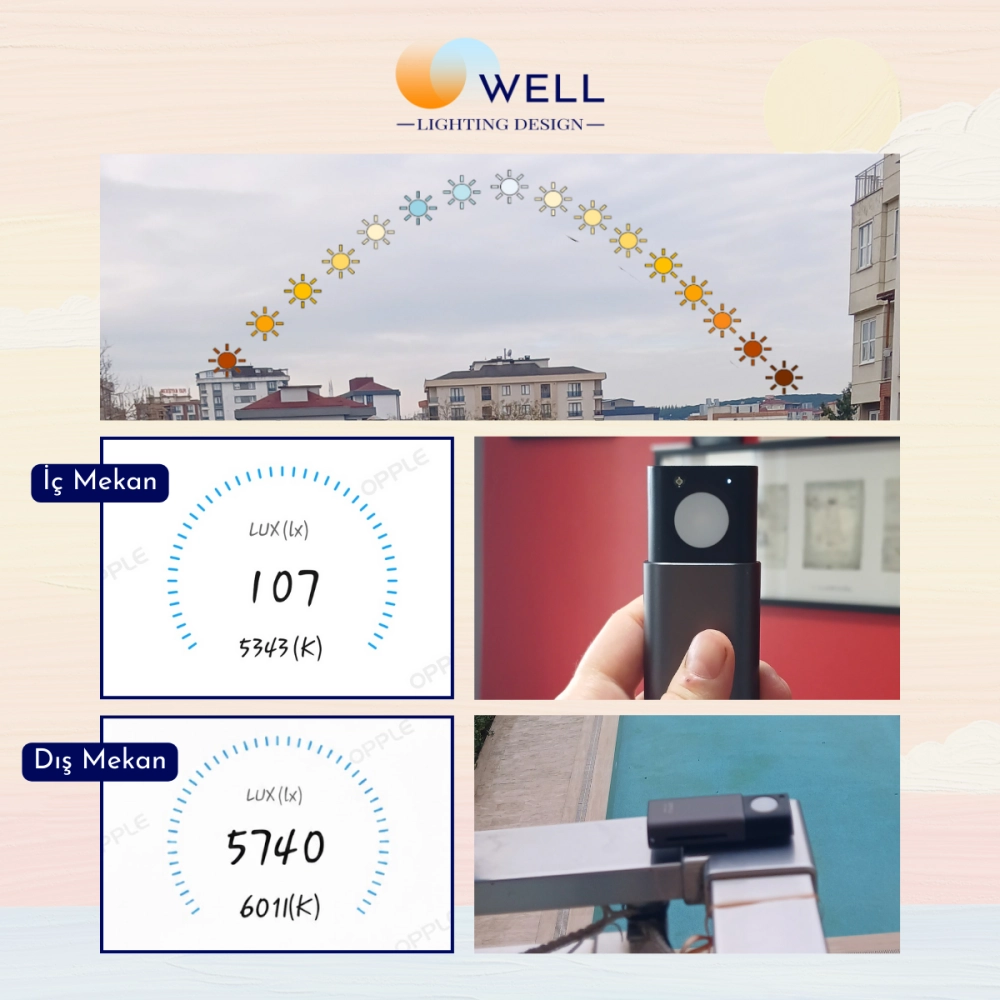
Human-Centric Lighting approach affects not only work performance but also sleep quality, stress levels, and long-term health. The light spectrum we're exposed to throughout the day directly regulates the body's biological clock. For this reason, interior lighting design should take into account not only visual comfort criteria, but also biological impact parameters.
What Is the Difference Between Photopic Lux and Melanopic Lux?
The term lux which we frequently encounter in lighting standards actually refers to limits defined purely by the eye's visual function. Today, however, we're talking about a far more critical concept: melanopik lux.
Melanopic lux is not directly related to vision. Depending on the proportion of blue wavelength within the light, it influences the balance of hormones such as melatonin, serotonin, dopamine, and cortisol. This means that identical photopic lux values, at different colour temperatures, can produce entirely different effects on circadian rhythm.
For this reason, modern lighting designmust take into account not only visual comfort but also biological impact.
What Does the Data Tell Us?
My own measurements show that indoors, throughout the day, we are exposed to light levels well below what we actually need (a minimum of 250, and ideally 1,000–2,000 melanopic lux).
These levels may be sufficient for perceiving a space, reading, or finding our way around. Unfortunately, they are not sufficient for attention, alertness, mood, and mental clarity. Many of the performance and sleep issues common in modern life are directly linked to poor lighting conditions.
As energy-efficient design becomes increasingly common in today's offices and residential buildings, access to natural daylight remains limited in many spaces. This makes it harder for occupants to reach adequate melanopic light levels during the day — a gap that becomes especially pronounced in enclosed-plan offices and deep-plan buildings.
How Does a Lighting Designer Light Their Own Workspace?
So, as a lighting designer what do I do when daylight isn't sufficient in my own workspace?
Bringing our bodies and minds into alignment with nature is actually easier than we might think.
Morning and Midday
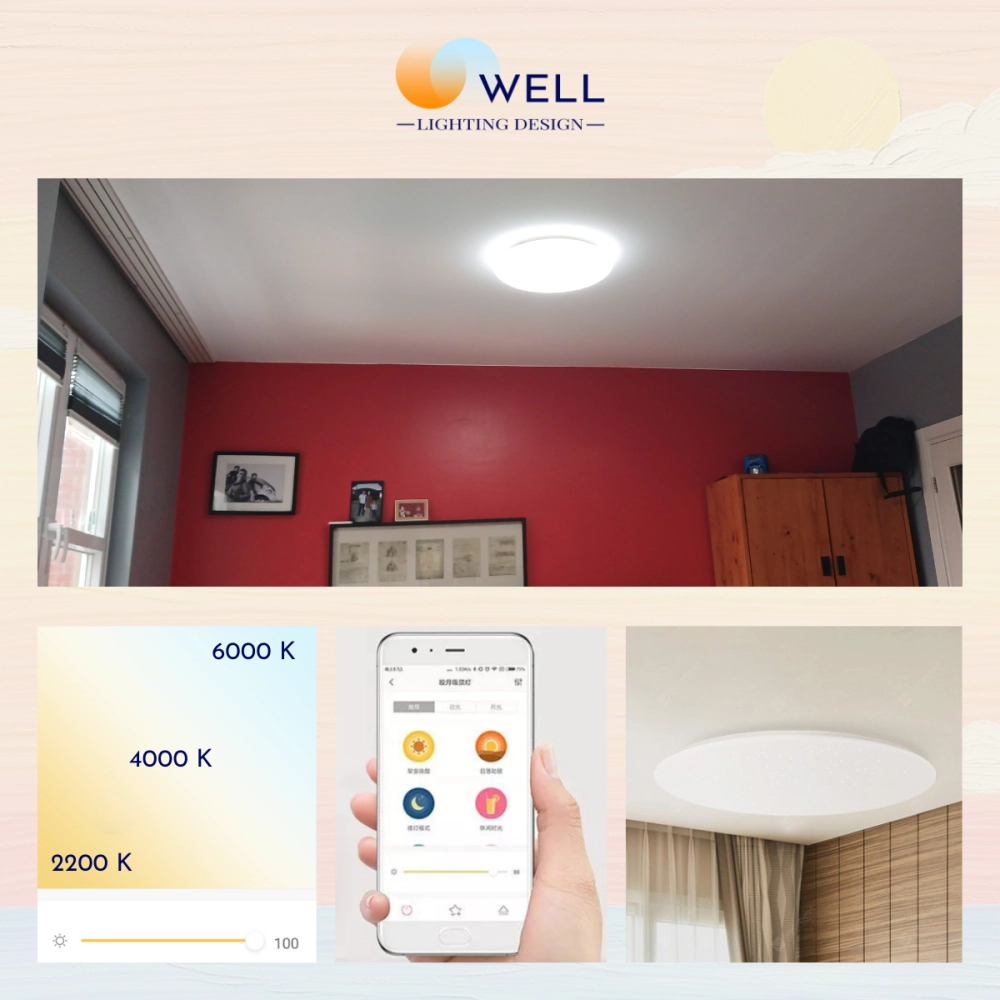
I start the day with high-energy light in the 6000K–6500K range. These values boost alertness and support cortisol balance.
Afternoon
I shift the colour temperature down to 4000K–3000K, gradually preparing the biological rhythm for rest.
After Sunset
I opt for soft light in the 2700K–2200K range, below 250 lux, to prevent melatonin suppression.
A Tip
When I need to check on my children at night, or wake up for a glass of water, I use only dim, red light — just enough to find my way. Switching on overhead lights at night causes a sharp drop in melatonin levels, and it can take 2–3 hours for the body to rebalance.
Healthy Lighting Is No Longer a Luxury
In professional projects, Human-Centric Lighting systems,deliver added value that far outweighs the investment cost. From hotels to offices, schools to hospitals — for organisations that value their employees, students, and brand reputation, this approach is no longer optional; it is a deliberate investment.
Healthy lighting design is no longer simply an aesthetic choice — it is a strategic decision that directly shapes user experience and brand perception. Lighting solutions that improve employee satisfaction, support focus, and respect biological rhythm can more than offset their cost through increased productivity and long-term health benefits.
With a well-planned lighting consultancy process, biological impact, visual comfort, and energy efficiency can all be optimised together. aydınlatma danışmanlığı süreci ile biyolojik etki, görsel konfor ve enerji verimliliği birlikte optimize edilebilir.
Conclusion:
Human-Centric Lighting is one of the most important topics in modern lighting design. Looking beyond photopic lux values to assess melanopic effect makes it possible to create healthier, more balanced lighting scenarios indoors. With a well-planned lighting consultancy process, both visual comfort and biological alignment can be achieved together.
Remember — the right light doesn't just transform a space; it transforms quality of life.
In your living or working spaces, are you focusing only on light's function for vision — or are you also taking your biological clock into account?
References
-
CIE (2020). Human Centric Lighting in the Workplace (CIE TN 011:2020)
https://cie.co.at/publications/human-centric-lighting-workplace -
Lighting Research Center. Healthy Buildings Program
https://www.lrc.rpi.edu/resources/newsroom/lightinganswers/healthy.asp -
International WELL Building Institute. Light Concept Overview
https://www.wellcertified.com/feature/light
Well-planned light doesn't just transform a space — it transforms the experience within it.
If you'd like to integrate the Human-Centric Lighting approach into your projects, get in touch with us. .
Let's add value to your projects with light!
WELL Lighting Design develops lighting design projects that are human-centered, sustainable, and enhance the character of spaces.
Contact us to add value to your projects.
well@well-lighting.com
+90 555 239 82 83
Cekmekoy, Istanbul
FOLLOW US!
© 2026 WELL Lighting Design